True design ambient
Start from the project specification; Gulf projects typically specify 46–50 °C dry-bulb. Add a margin for rooftop heat and warm-air recirculation between units.
Application · Gulf & desert sites
In the Gulf a dry cooler has to reject full heat on the hottest afternoon of the year. We select coil, fans and pre-cooling against your real design ambient, not a 32–35 °C catalogue point.
The physics
A dry cooler can only cool fluid toward the temperature of the air entering the coil. Its capacity depends on the inlet temperature difference (ITD): fluid inlet temperature minus air inlet temperature. For a given coil, fluid and flow, capacity scales roughly in proportion to ITD.
A unit selected at a European 35 °C design point loses a large part of its capacity at 46–50 °C. There are three levers: select at the true design ambient, raise the loop temperature where the process allows, and pre-cool the air.
Worked example
One coil, fluid entering at 60 °C, same fluid and flows. Only the air entering the coil changes.
| Air entering the coil | ITD | Capacity vs 35 °C rating |
|---|---|---|
| 35 °C dry-bulb (typical European rating point) | 25 K | 100 % |
| 46 °C dry-bulb | 14 K | ≈ 56 % |
| 50 °C dry-bulb | 10 K | ≈ 40 % |
| 46 °C dry-bulb, adiabatic pre-cooled to ≈ 34 °C (28 °C wet-bulb, ≈ 65 % pad efficiency) | ≈ 26 K | ≈ 103 % |
Indicative only: capacity is taken as proportional to ITD for the same coil, fluid and flow. Real selections use full coil ratings with the actual fluid, flow, altitude and air-side conditions.
Design points
Start from the project specification; Gulf projects typically specify 46–50 °C dry-bulb. Add a margin for rooftop heat and warm-air recirculation between units.
Every kelvin of loop temperature adds a kelvin of ITD. Engine HT circuits and hot process loops keep a usable ITD at 50 °C; loops returning below about 45 °C usually need pre-cooling or a trim chiller at peak.
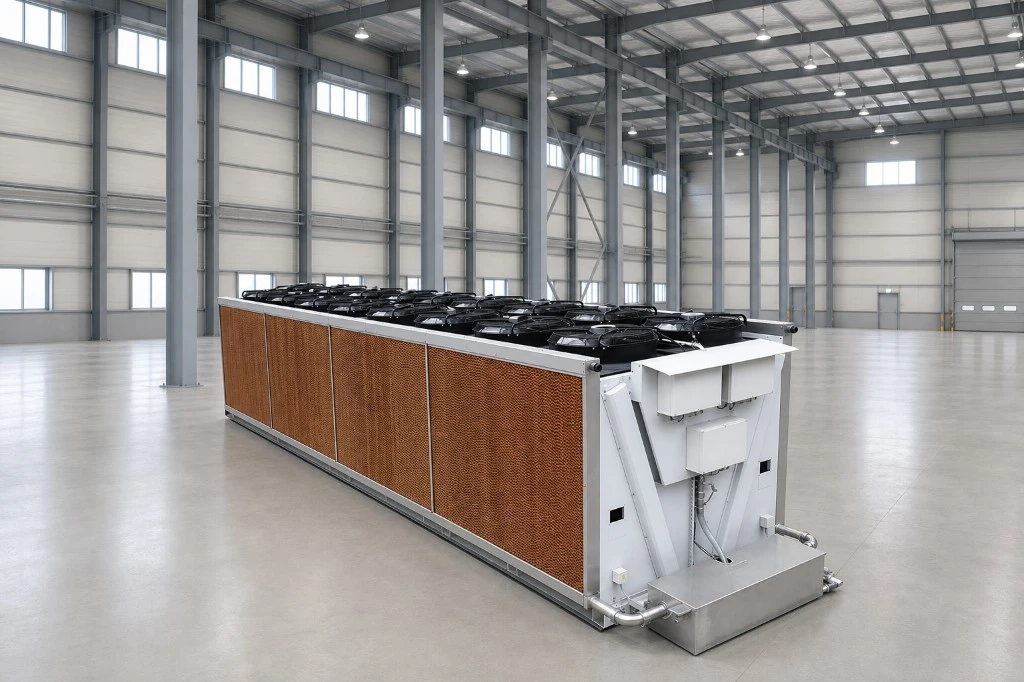
Wetted pads cool the inlet air toward wet-bulb only when the dry coil cannot hold setpoint. Pad water quality matters with high-TDS supplies, so we size bleed and treatment with the unit.
Fan motors and EC electronics must be rated for the design air temperature plus solar gain. We confirm the fan maker's permitted air temperature for each selection.
Site conditions
Coastal Gulf sites combine heat with salt and humidity; inland sites add sand and dust. Epoxy-coated fins, suitable fin spacing and cleaning access keep performance from falling away after the first dusty season.
Layout matters as much as the coil. Units placed too close to walls or to each other re-ingest their own warm discharge air, which raises the effective ambient by several kelvin. We check spacing, wall height and prevailing wind with the selection.
Selection information
A duty point plus the site is enough for a first selection. We will ask for anything that is missing. To re-rate a catalogue capacity to your ambient, use the sizing calculator.
FAQ
Use the project specification first. Gulf projects commonly specify 46–50 °C dry-bulb, and roof-mounted units often add 2–3 K for heat pick-up and recirculation. Selecting at a European 32–35 °C rating point badly undersizes the unit.
Yes, if the fluid entering the cooler is well above 50 °C; engine HT circuits and hot process loops are typical. When the fluid inlet is within a few kelvin of the air temperature, adiabatic pre-cooling or a trim chiller is usually more economical than a very large dry coil.
Only the water evaporated on the pads plus bleed for water quality, and only in hours when the pads are active. That is well below an equivalent cooling tower, but in the Gulf the pads can run for a large share of summer hours, so annual use is estimated from site weather data.
Related