Load following
Electrolyzers fed from solar and wind ramp up and down every day. EC fans modulate to hold loop temperature at part load and avoid overcooling on cold nights.
Application · Green hydrogen
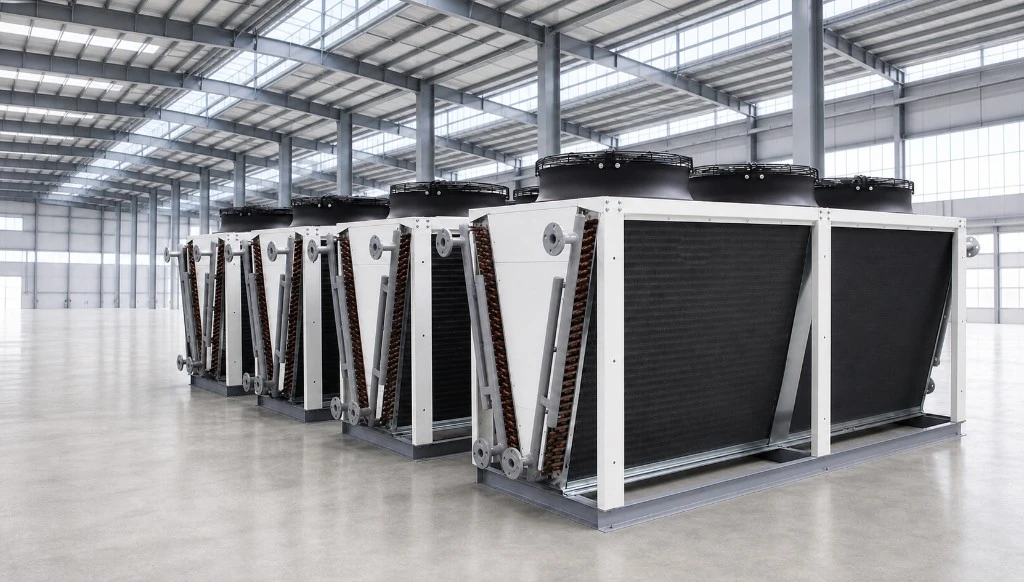
Every electrolyzer turns a large share of its input power into low-grade heat. We size closed-loop dry coolers for stack and balance-of-plant loops, so the plant rejects that heat without using cooling-tower water.
Heat load
Commercial alkaline and PEM systems convert roughly 60–70 % of their electrical input into hydrogen energy (LHV basis). Most of the rest leaves as heat in the stack cooling loop and in balance-of-plant equipment, so a plant can need heat rejection of roughly 25–35 % of its electrical rating. Stack efficiency falls with age and the heat load rises, so end-of-life duty is the usual design case.
Green hydrogen plants are often built where sun and wind are strongest: deserts, coastal plains and dry inland sites, where water is scarce. Every cubic metre evaporated in a cooling tower has to be sourced, treated and permitted. Closed-loop dry coolers reject the heat to air instead, and the loop fluid stays in the system.
Heat sources
| Heat source | Temperature level | Notes for dry cooler selection |
|---|---|---|
| Stack cooling (via plate heat exchanger) | Alkaline stacks operate around 70–90 °C, PEM around 50–80 °C | The main load. Warm loop temperatures leave a good margin to ambient air, which suits dry cooling year-round. |
| Gas cooling and drying (H₂ / O₂ coolers, dryers) | Low; often needs fluid below about 35–40 °C | Small approach to summer ambient. May need adiabatic pre-cooling or a trim chiller at hot sites. |
| Rectifiers and transformers | Moderate, within the power supplier's limits | Often a separate electronics loop. Confirm allowed coolant temperatures with the power electronics supplier. |
| Compressors | Depends on compressor type | Usually a separate circuit; can share a dry cooler bank using separate coil sections. |
Indicative ranges for orientation. Stack and balance-of-plant temperatures depend on the electrolyzer OEM and are taken from their process data for each selection.
Design points
Electrolyzers fed from solar and wind ramp up and down every day. EC fans modulate to hold loop temperature at part load and avoid overcooling on cold nights.
Stack and balance-of-plant loops run at different temperatures. Separate banks or split-circuit units keep the cold loop from being sized by the hot one.
Design ambient, sand and salt drive fin spacing, coil coating and cleaning access. Adiabatic pre-cooling is an option where some water is available for peak hours.
Dry cooler banks can be matched to stack modules, with fan redundancy and isolation valves so one module can be serviced while the plant runs.
Selection information
Process data from the electrolyzer OEM plus site conditions is enough for a first selection. We will ask for anything that is missing. To check duty and flow first, use the sizing calculator.
FAQ
For orientation, plan heat rejection of roughly 25–35 % of the electrolyzer's electrical rating, split between the stack loop and balance-of-plant loops. Use the OEM's process data, and design for end-of-life stack efficiency, when the heat load is highest.
The stack loop usually runs warm enough for dry cooling even at high ambient. Low-temperature balance-of-plant loads such as gas coolers may need adiabatic pre-cooling or a trim chiller at peak conditions, and the selection shows that split.
Our scope is the outdoor dry cooler on the glycol loop. The stack-side plate heat exchanger and deionised-water circuit stay with the electrolyzer OEM or integrator; we review the interface temperatures with you.
Related