Approach vs chiller hours
Each extra kelvin of approach shrinks the coil but adds chiller or adiabatic hours. We show the selection at your target approach and one step either side.
Application · Liquid-cooled data centers
Direct-to-chip and immersion cooling run warm enough for dry coolers to reject most or all of the heat without compressors. We size the dry coolers on your facility water loop to its supply temperature, redundancy basis and site ambient, as a second source or an alternate quote.
Heat path
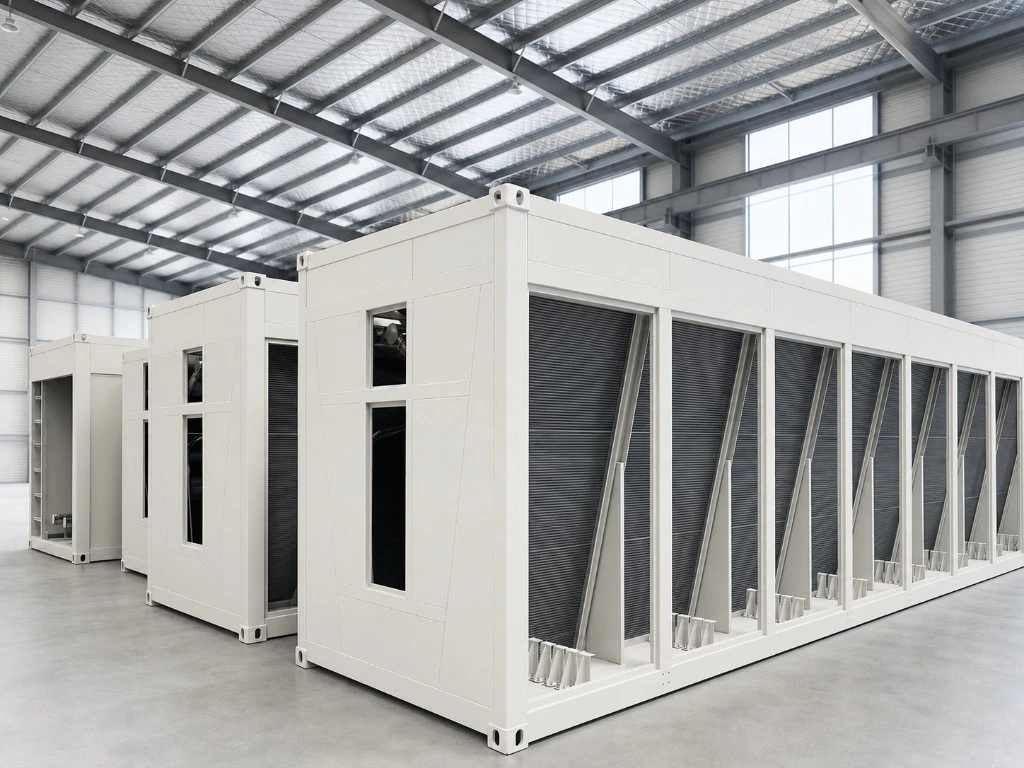
Heat moves from the chip into a cold plate or immersion fluid, through the technology cooling system (TCS) loop to the coolant distribution unit (CDU). The CDU's heat exchanger passes it to the facility water system (FWS), and the dry coolers on that loop reject it to outdoor air. The TCS runs a few kelvin warmer than the facility water because of the CDU approach.
ASHRAE's liquid cooling guidelines group facility water by supply temperature: W17, W27, W32, W40, W45 and W+. The class sets how many hours the dry coolers can hold that supply on their own, and so how much chiller or adiabatic support the site needs. Warm returns can go to heat recovery first, with the dry coolers rejecting what is left.
Water class
Highest ambient at which dry coolers alone still hold the facility water supply, assuming a 6 K approach.
| Facility water class | Supply to CDU | Dry-only up to about | What it means for the site |
|---|---|---|---|
| W27 | 27 °C | 21 °C ambient | Chiller or adiabatic support for many hours in most climates. |
| W32 | 32 °C | 26 °C ambient | Dry-only for most of the year in northern and central Europe; support needed at summer peaks in warmer climates. |
| W40 | 40 °C | 34 °C ambient | Dry-only year-round at many temperate sites; adiabatic assist at peaks in hotter regions. |
| W45 | 45 °C | 39 °C ambient | Dry-only in most climates; desert sites still need a plan for the hottest hours. |
Indicative only. The approach between facility water supply and ambient depends on coil size and fan power; a tighter approach extends dry-only hours but costs more coil. Check your own numbers with the dry cooler sizing calculator, and see high-ambient sizing for 45–50 °C sites.
Design points
Each extra kelvin of approach shrinks the coil but adds chiller or adiabatic hours. We show the selection at your target approach and one step either side.
Unit-level N+1 or N+N with isolation valves, so any unit can be serviced under load. Per-fan electrical protection keeps a single fan fault from stopping a unit.
Outdoor loops in cold climates need glycol or a separating heat exchanger. Glycol lowers capacity and raises pump head, so the coil is rated with the real mixture.
IT load ramps in phases. EC fans run slower and quieter at part load and take their setpoint from the BMS over 0–10 V or Modbus.
Selection information
A loop schedule plus site conditions is enough for a first selection. You can check duty and flow first with the sizing calculator.
FAQ
Often, yes. With warm facility water (ASHRAE W32–W45), the dry cooler holds the supply temperature whenever the ambient is a few kelvin below it. Whether that covers every hour depends on the water class, the approach and the local design ambient; hot sites add adiabatic pre-cooling or a trim chiller.
Commonly 5–8 K between facility water supply and design dry-bulb. A tighter approach needs more coil and fan power; a wider one needs more chiller or adiabatic hours. We can quote both so the trade-off is visible.
Typically unit-level N+1 or N+N with isolation valves, so any unit can be serviced under load, plus individual fan protection so one fan fault does not stop a unit. The redundancy basis comes from your design, and the selection is sized to it.
Related